
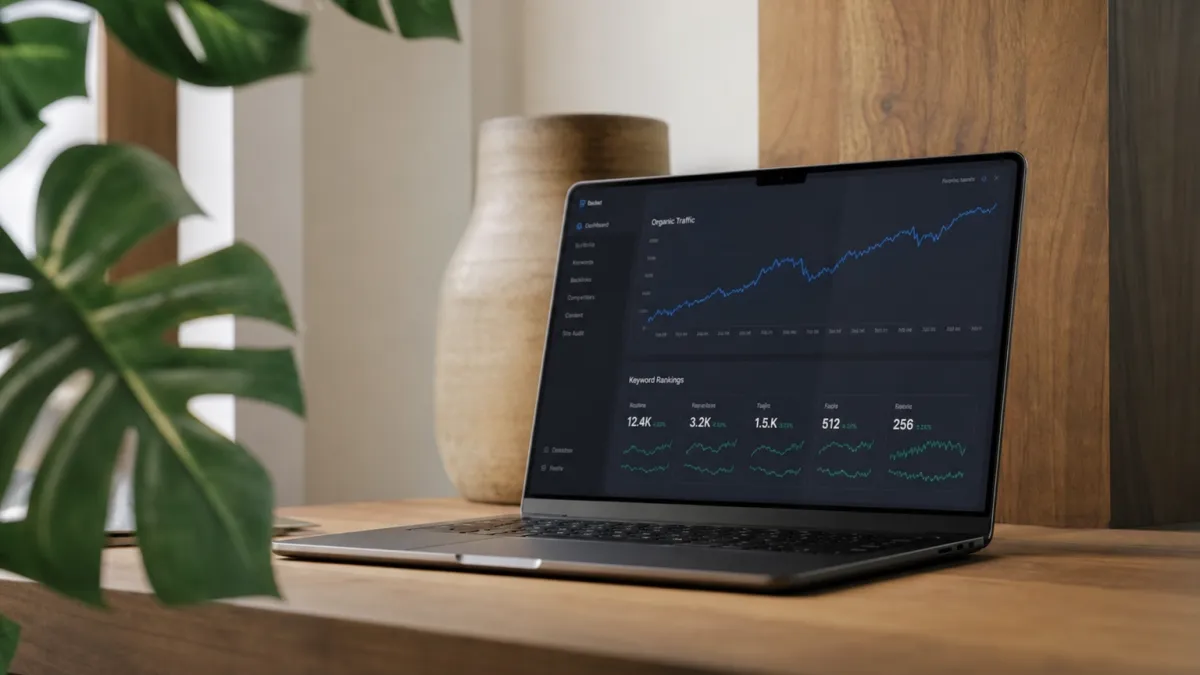
Organic traffic numbers don't lie — and for SEO specialists managing multiple properties, even a modest improvement in click-through rates can shift rankings meaningfully. ClickSEO addresses that gap directly, giving digital marketers a structured way to influence the traffic signals that search engines actually measure.
Understanding ClickSEO's impact on traffic
Among traffic generation platforms, ClickSEO has carved out a distinct position by directly influencing the organic metrics that search engines use to evaluate a site's authority and relevance.
Key features of ClickSEO
Simulating organic behavior starts at the signal level. ClickSEO replicates natural mouse movements and variable dwell time, giving every session a human-powered feel that distinguishes it from crude bot traffic — the kind search engines have learned to filter out almost instantly.
Geo-targeting reaches 170+ countries, enabling tightly localized campaigns that match real search intent patterns. Average session duration runs between 1 and 5 minutes, a range calibrated to mirror genuine user engagement rather than mechanical page hits. That variance matters: consistent, suspiciously identical session lengths are a red flag for analytics platforms. Keyword targeting adds another layer of precision — the recommended click volume sits at 5–15% of a keyword's daily search volume, keeping traffic signals within thresholds that look credible to both Google Analytics and organic ranking algorithms. Together, these features form a coherent system for shaping behavioral metrics with accuracy.
Practical benefits for SEO
Click-through rate is officially ranked as the 4th most critical SEO ranking factor by search engines — a signal that static on-page optimization alone cannot manufacture. Google's NavBoost system compounds this reality by rewarding behavioral signatures over keyword density, meaning that real engagement patterns directly influence ranking trajectories. ClickSEO addresses this gap by simulating user sessions with controlled visit durations and reduced bounce rates, feeding NavBoost the behavioral data it prioritizes. For SEO professionals, this translates into measurable keyword ranking improvements without waiting months for organic traction to compound. Site owners gain a practical lever to reinforce underperforming pages, accelerating the feedback loop between content quality and search engine recognition.
How ClickSEO works
Traffic generation techniques
Residential IPs are non-negotiable here — generic bot traffic gets flagged almost instantly by modern detection systems. ClickSEO routes visits through residential IP addresses, making each session appear as a legitimate user browsing from a real device and location. Layered on top of that, human-like interaction patterns — variable scroll depth, realistic dwell time, natural click sequences — ensure search engines register authentic behavioral signals rather than automated noise.
Ensuring safe SEO practices
Scroll depth, dwell time, and behavioral consistency now carry as much weight as backlinks in how search engines assess page quality. Generic bot traffic fails precisely here — triggering detection patterns that can suppress rankings rather than lift them. ClickSEO sidesteps this by mimicking genuine user behavior at the signal level, making each simulated session indistinguishable from an organic visit and keeping your analytics profile clean from penalty-triggering anomalies.
With its mechanics now clear, the real question is how ClickSEO stacks up against competing tools on the market.
Comparing ClickSEO with other tools
ClickSEO vs. competitors
Not all traffic generation tools are built for the same job. Apex Traffic, for instance, appeals to small businesses with tight budgets seeking basic visibility — but it falls short when competitive keyword targeting demands precision. ClickSEO operates in a different league, deploying advanced CTR engineering to send engagement signals that directly influence ranking factors. Its hybrid framework connects traditional SEO logic with high-frequency behavioral automation, a combination most standalone tools simply don't offer.
That structural gap becomes clear when comparing core capabilities side by side:
| Feature | ClickSEO | Competitors |
|---|---|---|
| Free Trial | 3 days | Varies |
| Geo-targeting | 170+ countries | Limited |
| Pricing | $30.00 – $900.00 | Varies |
| Keyword-driven visits | Yes | Rarely available |
| Bounce rate control | Granular | Basic or absent |
The pricing range reflects genuine flexibility — entry-level plans suit solo operators, while upper tiers serve agencies managing multiple domains. The 3-day trial, shared with SearchSEO, lowers the barrier to testing without financial commitment.
Unique advantages of ClickSEO
Residential IPs and human-like interaction patterns give ClickSEO a structural edge that generic bots simply cannot replicate. Where most traffic tools trigger detection layers almost immediately, this platform routes sessions through residential addresses, making each visit indistinguishable from genuine user activity at the network level.
Google's NavBoost system has fundamentally shifted how rankings are influenced — behavioral signatures now carry more weight than static keyword density alone. ClickSEO's organic traffic simulation is built precisely around this reality: scroll depth, dwell time, and session continuity are all calibrated to mirror real user behavior. These signals have become as impactful as backlinks for SEO performance, which means a tool that ignores them is leaving ranking leverage untouched. By aligning its simulation engine with the exact behavioral data NavBoost processes, ClickSEO delivers visits that don't just inflate numbers — they generate the kind of engagement patterns that search algorithms are actively rewarding today.
Implementing ClickSEO for maximum impact
Setting up your campaign
Initial setup
Starting with 30 to 100 clicks per day is the recommended baseline — a range calibrated to mimic natural traffic growth without triggering anomaly flags in analytics platforms. Keeping volume at the lower end suits newer domains, while established sites can safely push toward the upper threshold. Campaign configuration should also account for timeline expectations: results typically emerge within 2 to 6 weeks, depending on domain authority, keyword competitiveness, and session parameters set at launch.
Executing the campaign
Session dwell time — set between one and five minutes — is what separates credible traffic simulation from patterns that trigger algorithmic scrutiny. Once the campaign runs, prioritize URLs ranked between positions 11 and 30: that's where CTR manipulation carries the most weight, nudging pages across the visibility threshold. Keeping visit durations within that window signals genuine user engagement to Google's behavioral systems, accelerating ranking momentum where it actually counts.
Optimizing for best results
Positions 11–30 represent the highest-leverage window for CTR manipulation — rankings close enough to page one that a measurable signal boost can push a URL over the threshold, yet far enough that search engines register the uplift as organic momentum rather than noise. Targeting this range with ClickSEO's keyword-driven visits, while keeping session duration and scroll depth consistent with genuine user behavior, accelerates the feedback loop. Campaigns typically show measurable ranking movement within 2–6 weeks, a timeline that shortens when geo-targeting aligns with the site's primary audience and bounce rate parameters mirror niche-specific benchmarks. Concentrate volume on your most competitive mid-range keywords first, then redistribute budget upward as positions climb.
Monitoring and adjustments
Tracking performance
Campaign results from ClickSEO typically surface within 2 to 6 weeks — a window that demands disciplined tracking from day one. Set up Google Search Console and Google Analytics to monitor keyword position shifts, session duration, and organic click-through rate in parallel. The most telling signal comes from positions 11–30, where CTR manipulation has the greatest leverage: a URL moving from page two into the top ten represents a measurable ranking gain directly attributable to sustained traffic signals. Cross-reference these movements weekly to distinguish genuine progress from natural fluctuation.
Making adjustments
Keeping daily click volume between 30 and 100 visits is the baseline for a new campaign, but the real optimization happens when you read performance signals and respond to them. If dwell time consistently falls below the one-minute threshold — when the target window runs from one to five minutes — tighten your session duration settings and review the landing pages receiving traffic. Conversely, strong engagement metrics justify a gradual volume increase. Incremental scaling prevents unnatural traffic spikes that could distort your analytics data and undermine the credibility of the behavioral signals you're building.
For websites stuck in low-visibility cycles, a tool that replicates genuine user behavior — with keyword targeting, geo-precision, and bounce rate control — removes a real barrier. ClickSEO is worth testing firsthand.
Questions fréquentes
Is CTR manipulation with ClickSEO safe for my website's SEO?
Yes — when executed responsibly. ClickSEO uses residential IPs and human-like micro-behaviors (scroll depth, dwell time of 1–5 min) to bypass Google's 2024+ detection layers, minimizing penalty risk significantly.
How long does it take to see ranking improvements with ClickSEO?
Behavioral signals are registered within days, but material SERP gains typically appear between weeks 2 and 6. Keywords already ranking at positions 11–30 respond fastest to sustained CTR campaigns.
What daily click volume should I target when starting a ClickSEO campaign?
Start conservatively: 30–100 clicks/day, representing roughly 5–15% of a keyword's organic daily search volume. This threshold ensures growth patterns appear natural to Google's NavBoost system.